How to Reduce Missed Follow-Ups in BPO Customer Operations
Learn how BPO teams can reduce missed follow-ups with CRM task queues, call notes, dispositions, customer history, and manager review.
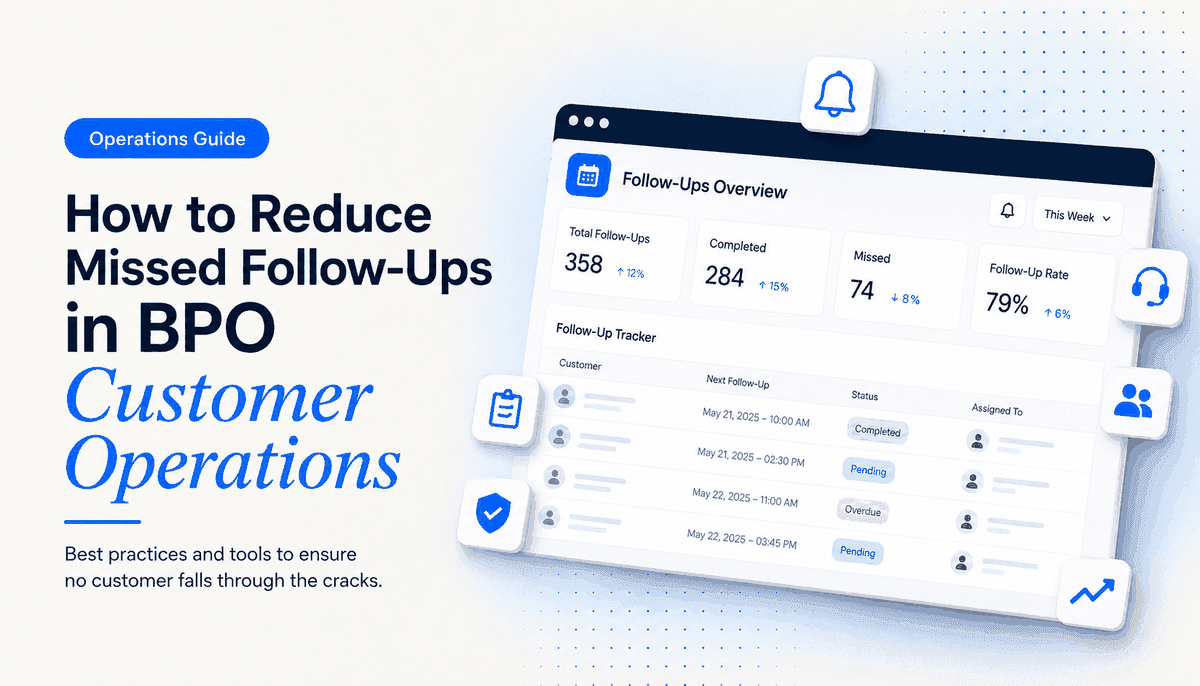
reduce missed follow-ups BPO is a practical decision about control, visibility, and daily execution. For BPO managers dealing with callbacks, unresolved tickets, and handoff gaps between agents, the right setup is the one that keeps customer work, agent activity, workforce records, and manager review in one clear operating flow instead of spreading decisions across disconnected tools.
What reduce missed follow-ups BPO means for BPO teams
In a BPO or call center, software is not only a place to store data. It is the daily operating system for agents, supervisors, HR, and management. The question behind this topic is simple: can the team see what happened, who owns the next action, and where the next operational risk is?
This is why Telvora content treats reduce missed follow-ups BPO as part of the wider BPO operations platform. CRM, dialer workflows, monitoring, attendance management, HRMS, managed VPN, Data Refine, chat, reporting, and upcoming native VoIP all touch the same management problem: disconnected workflows make it harder to run a clean service operation.
Why this problem appears as the team grows
The early version of a BPO is usually simple. A few agents can work from spreadsheets, messages, basic calling tools, and manual manager review. That setup starts to break when shifts increase, campaigns overlap, customers need follow-up, HR records expand, and managers need reports without stopping the team for updates.
For this topic, the main warning sign is that agents finish calls without a clear next action, notes live in separate tools, managers cannot see overdue work, and customers get contacted late. When that happens, the issue is no longer only about a missing feature. It becomes a control problem that affects customer experience, team accountability, reporting speed, and owner confidence.
Teams often try to fix this by adding another sheet, another approval message, or another standalone tool. That can help for a week, but it usually creates another place where data must be copied, cleaned, checked, and explained. A stronger approach is to design the workflow around the manager decision that needs to happen every day.
Untracked follow-up vs CRM task workflow
The comparison below shows the operational difference buyers should look for. A good system does not only record activity; it makes the next action visible and gives managers a cleaner way to review the work.
| Area | Untracked follow-up | CRM task workflow |
|---|---|---|
| No next action | Call ends without an owner | Require follow-up task |
| Lost context | Notes live outside CRM | Keep history beside the record |
| Manager blind spot | No overdue view | Review task queues daily |
| Repeated calls | No outcome standard | Use dispositions |
Checklist: signs you should upgrade the workflow
Use this checklist before buying or rebuilding anything. If several points are true, the team needs a more structured operating workflow, not only a cosmetic dashboard.
- Assign every follow-up to one owner.
- Use due dates for next action.
- Store call notes beside the customer record.
- Use dispositions for standard outcomes.
- Review overdue tasks each shift.
The checklist is also useful for implementation planning. Each point can become a requirement, an owner, and a test case during rollout. That keeps the discussion specific and prevents the project from becoming a vague software replacement.
How to choose the right setup
Start by mapping the workflow from the agent's first action to the manager's final review. For example, a customer call should connect to a customer record, a disposition, a note, a possible follow-up task, and a manager view. Attendance should connect to shifts, leaves, exceptions, and HR records. Data cleanup should happen before calling, not after agents waste time on bad lists.
Then decide which system should be the source of truth. For customer operations, that is usually CRM. For calling, it is the dialer workflow connected to CRM. For workforce records, it is HRMS and attendance management. For oversight, it is monitoring and reporting. If there is no source of truth, every report becomes a negotiation between tools.
Finally, avoid overbuilding. A new or growing BPO does not need every enterprise feature on day one. It needs the right control points: clear ownership, clean records, consistent workflows, role-based access, and reports that managers actually review.
Internal links for the next step
If this is your current bottleneck, start with the most relevant Telvora service page: reduce missed follow-ups BPO. For the connected workflow, also review the related Telvora service. If you are still deciding which module should come first, use the full Telvora services overview or book a demo so the setup can be mapped around your team.
Implementation plan for BPO teams
- Document the current workflow. Write down where the work starts, which team owns it, which tools are involved, and where managers currently lose visibility.
- Define the required fields. Decide which customer, call, attendance, HR, access, or reporting fields must be captured every time.
- Set roles and permissions. Separate agent, supervisor, HR, admin, and owner views so each person can act without unnecessary access.
- Pilot with one team or shift. Test the workflow with a small group before changing the whole operation.
- Review reports weekly. Check whether the new workflow reduces manual follow-up, unclear ownership, and reporting delays.
How Telvora helps
Telvora is built for BPO and service operations teams that need customer, calling, workforce, HR, access, data quality, and reporting workflows to move together. Instead of positioning one module as the whole answer, Telvora connects the operating layer around how managers actually run call center and BPO teams.
For teams evaluating reduce missed follow-ups BPO, the practical goal is not to add software for its own sake. The goal is to reduce scattered work, create clearer accountability, and give managers a reliable view of what needs attention. Telvora supports that through CRM, dialer workflows, monitoring, attendance management, HRMS, chat, managed VPN, Data Refine, reporting, and upcoming native VoIP.
Review the most relevant Telvora module, then contact Telvora to map the right implementation path for your BPO or call center.
FAQs
Why do BPO teams miss follow-ups?
Follow-ups are missed when ownership, due dates, call notes, and customer history are not managed in one workflow.
Can CRM reduce missed follow-ups?
Yes. CRM helps by keeping tasks, notes, due dates, and customer records together.
Should call outcomes create tasks?
Yes. Important call outcomes should create or update follow-up tasks so the next action is visible.
How often should managers review follow-ups?
Managers should review overdue and high-priority follow-ups daily, especially before or after busy calling shifts.